Pour the lukewarm milk into a bowl and stir in 1 teaspoon of the sugar and the yeast. Let this mixture sit for 5-10 minutes until it becomes foamy—this proves the yeast is alive and active. In a separate bowl, whisk together the flour, salt, and remaining 1/3 cup sugar. Once the yeast mixture is foamy, stir in the egg and vanilla extract, then combine this wet mixture with the flour mixture, stirring until a shaggy dough forms. Don't overwork it at this stage.
Cover the dough from Step 1 with plastic wrap and let it rest at room temperature for 30 minutes. This allows the gluten to relax and makes the dough easier to work with. While the dough rests, cut the cold unsalted butter into small pieces and grate it on the large holes of a box grater, keeping it as cold as possible—I find Kerrygold's high fat content makes it easier to work with and creates beautiful, flaky layers. Keep the grated butter in the freezer until you're ready to use it.
On a lightly floured surface, roll the rested dough into a rectangle approximately 12x8 inches. Scatter the cold grated butter from Step 2 over the top two-thirds of the dough, leaving the bottom third bare. Fold the bottom third up, then fold the top third down over it, creating three layers like a letter. You've now completed the first fold. Rotate the dough 90 degrees, then roll it out again to a 12x8 rectangle.
Repeat the folding process 4 more times, rotating the dough 90 degrees after each fold. Each time, fold the dough in thirds like a letter without adding more butter—you're simply folding the existing layers to create more sheets. After the fifth fold, wrap the laminated dough tightly in plastic wrap and refrigerate for 4-24 hours. The longer chill allows the butter to set properly between layers and develops flavor. This is the critical step that creates the danish's signature flaky texture.
Combine the blueberries, 3/4 cup sugar, cornstarch, lemon zest, and lemon juice in a saucepan. Bring to a simmer over medium heat and cook for 15-20 minutes, stirring occasionally, until the mixture thickens and the blueberries begin to break down slightly. The cornstarch will thicken the filling so it doesn't run out during baking. Pour the filling into a fine-mesh strainer set over a bowl and let it drain for 10-15 minutes, discarding the excess liquid. Transfer the thickened filling to the bowl and refrigerate until cold—this can be done while the dough chills or up to 24 hours ahead.
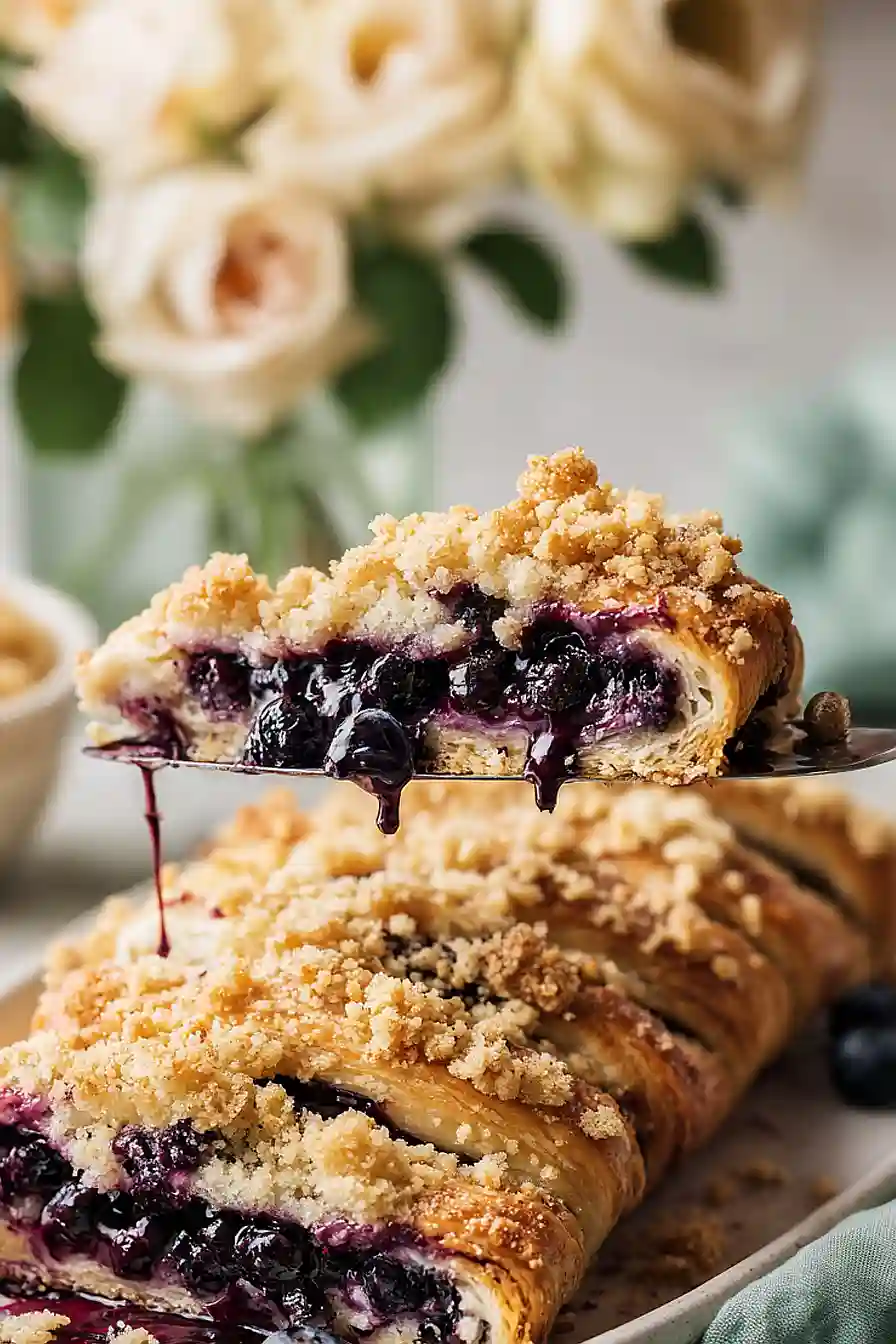
Remove the chilled laminated dough from Step 4 and roll it into a 12x10 inch rectangle on a floured surface. Score the dough lightly into three vertical sections (a 4-inch wide center strip with two 4-inch strips on each side). Using a sharp knife, cut 1-inch wide diagonal strips through both side sections, stopping at the score lines so the strips remain attached at the center. Spread the cold blueberry filling from Step 5 down the center section. Fold the cut strips alternately over the filling, creating a braided pattern. Transfer the braid to a parchment-lined baking sheet.
Cover the danish braid with plastic wrap and let it proof at room temperature for 30-60 minutes until slightly puffy. Preheat your oven to 395°F. Whisk together the egg yolk and 2 teaspoons of milk to create an egg wash, then brush it evenly over the entire surface of the danish. Sprinkle the 1/4 batch of streusel over the top. Bake for 25-30 minutes until golden brown and crispy. Let the danish cool on the baking sheet for 10 minutes before transferring to a wire rack to cool completely.